Monday, May 11, 2009

Update on the Shooting in Baghdad


After Mr. Lawler showed us the blog post in class yesterday about the solider that killed five of his comrades in Baghdad, I was able to find an article with an update of the latest information that has been released about the tragic event. On his third tour in Iraq, 44 year old Sgt. John M. Russell of the 54th Engineer Battalion, was charged with five counts of murder and one count aggravated assault at the Combat Stress Clinic at Camp Liberty in Baghdad. Two victims were staff at the clinic and the others were soldiers. Although his concerned commanders' referred him to counseling a week earlier and confiscated his weapon, Russel got into an argument with someone at Camp Liberty and grabbed another service member's weapon, returned to the clinic, and opened fire.

This shooting, although the most severe of kind, seems to be apart of a rising trend of disturbed soldiers. In a recent study it was found that "multiple lengthy deployments to war zones have led to a sharp rise recently in suicides and diagnoses of post-traumatic stress disorder." One in six returning soldiers from Iraq show signs of post traumatic stress disorder and other emotional issues and the suicide rate of soldiers is on the rise. This is a concerning finding. The style modern warfare is causing injury to soldiers to not only be physical but also mental. In an effort to reduce this statistics, military leaders have sought to educate service members about combat stress and its symptoms. However, as this tragic indecent proved, it has not been enough. What can the U.S. goveenment do to further educate and aide suffering soldiers? How can the combat stress facilities be restructured to be more effective? The latest deaths bring the number of U.S. soldiers killed in Iraq during the six-year war to about 4,292. according the the Associated Press count.

http://www.washingtonpost.com/wp-dyn/content/article/2009/05/12/AR2009051201127.html

Tuesday, May 5, 2009

Injured Soliders


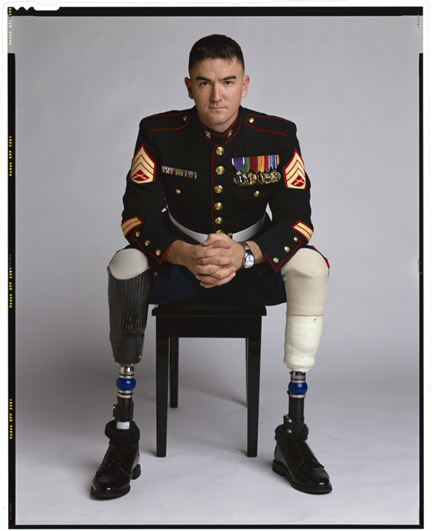
Yesterday I went on an excursion to Artropolis at the Merchandise Mart (an exhibition of contemporary and modern art), and one of the many exhibits was about the war in Iraq. The activist/artist used powerful images to send a message to the viewers that the war in Iraq was unjust and should be stopped. The one that moved me the most was a simple portrait of a man injured in the Iraq war. Similar to Ron Kovic, the man in the picture was in a wheel chair, but he had both legs aputated below the hip and in their place had two mechanical legs. He was proudly wearing a U.S. Marines uniform adorned with many medals. Not only did this image remind me of the young Ron Kovic from the film, but it also made me relize how little I have heard in the news about the injured. All the time there are reports of how many have died, but rarely are there details of wellbeing of those that have been injured and the effect their injury has had on their quality of life.

I was able to find a similar image of the same man online. His name is Marine Staff Stg. John Jones, and he is 30 years old and from San Antonio, Texas. He was featured in a HBO film about injured soliders titled "HBO's Alive Day Memories: Home From Iraq," which aired September 9, 2007. After about nine months of service in Iraq, Jones was sitting in the passenger side of a hummer that was hit by a double-stacked anti-tank mine in Iraq. In addition to being a double amputee, his other injuries from the accident include loss of hearing and memory, post tramautic stress disorder, and shrapnel in parts of thighs and wrists.

Although he now has a positive mental outlook on situation, many other soliders in a similar situation do not. Jones says that he "hopes to be a positive influence for others and set an example for those who have given up hope." In what mental and physical state is the war leaving soliders? How does this affect their quality of life?

Monday, April 27, 2009

The End of Vietnam and the Lessons the U.S. Learned


This Thursday will mark the 34th anniversary of the end of the Vietnam war, April 30th, 1975. In class we discussed some of the causes of the war and the reason for the involvement of the U.S., but we have not yet discussed the outcome of the war. To recap from class, the U.S. entered the war to stop the spread of communism from North Vietnam to other parts of Southeast Asia and beyond. However, the more interesting part more interesting part is the end of the war and its effect. After more than a decade and a half of fighting, the United States, North Vietnam, and South Vietnam signed the Paris Peace Accords, removing U.S. from Vietnam. This peace treaty came after widespread opposition to the war was occurring in the United States. Once the U.S. troops withdrew from South Vietnam, North Vietnam launched its final attack on the south. The north captured the southern capital of Saigon on April 30th, 1975, known as the fall of Saigon. The city was immediately renamed Ho Chi Minh City after North Vietnamese leader. Soon after the fall of Saigon, North and South Vietnam united as the Socialist Republic of Vietnam.

On the contrary to their original intent, the United States was very unsuccessful in ending communist rein in Vietnam. In the process, 58,000 Americans died and 153,000 were seriously wounded. In addition, 1 million Vietnamese combatants and 4 million Vietnamese civilians died over the years of fighting. Not to mention, many of the soldiers who came back physically unharmed were never the same mentally, with a large number of veterans suffering from post traumatic stress disorder. The Vietnam war taught the United States effects of military intervention in foreign countries, and how the outcome is not always pleasing. So in light of our unit guiding question, what was the Vietnam war good for? How can the concepts learned through Vietnam be applied to the War on Terror and the War in Iraq? What progress has been made between the wars in terms of the US's strategy?

Tuesday, April 14, 2009

The Cost of College


In the past 10 years, the tuition to attend a public, four-year college has increased over 50 percent. As the tuition increases, so does the amount of debt college students have. The average undergraduate student has $3,173 in credit card debt. Students are charging their school expenses to their credit cards, creating a huge amount of debt they will have to pay off once they are out of college and trying to make a living. The higher the grade level of the student, the more debt. The average college senior has $4,138 in debt, a 44 percent increase since 2004, and the highest this statistic has been since data for it has been collected. In addition, with the economic downturn, these statistics, which were collected for 2008, will still be on the rise for 2009. Lenders are declining private loans for college, leaving some people out of options for college funding (article). What should current high school students do to pay for college? According to this article, the high school graduating class of 2010, will be part of the largest entering college freshman class in U.S. history, a demographic blip that's leading to an admissions squeeze for some students. But the bigger squeeze is figuring out how to pay for the schools that accept them." So what happens when you get accepted into that "good" college of your dreams that you have worked your whole high school career for, but you cannot afford it? The economic downturn is causing student to apply to schools that are closer to home and cheaper, with an emphasis on in-state tuition. Many people's college funds have all but vanished with the stock market, and the average college endowment has dropped a quarter. Students that were counting on receiving financial aid may not be able to receive any, causing some people to loose their dream of going to any college at all. How will this affect the line between privilege and poverty? What will less people receiving a college education mean for the future of our economy?

The Obama administration has responded with a college affordability plan that includes phasing out bank-loan subsidies, transferring funding to small increases in grants for low-income students, expanding the federal student loan and Pell Grant programs and offering some assistance to students who enter public service. However, "even an infusion of government aid won't ease the pain much for most middle- to upper-income families, many of whom won't qualify for grants, need-based scholarships or significant education tax credits." This is where many New Trier students fall; they are in need of financial aid to afford those big price ticket private and out-of -state schools, bu they are not the worst off in the big, national need-based community, so they will not be receiving the aid they need.

Thursday, April 9, 2009

People getting desperate in a time of need?


In Wilmette on Saturday, two people robbed Fifth Third Bank on Green Bay Road. The robbers tied up two employees at closing using zip ties as hand cuffs. Dressed in black, ski masks, and sunglasses, the two men were able to escape with money and without harming either of the bank tellers. The police did not arrive in time, and are still on the lookout for the two men (Wilmette Life Article). This robbery led me to wonder if bank robberies have increased since the economic downturn. No surprise, it turns out they have. People have become desperate for any source of income, and have turned to stealing to get some extra cash. According to this article, bank robberies are up 54 percent in New York City in the last year. Experts say there is a direct correlation between recessions and the rise in bank robberies. During the Great Depression, Willie Sutton was notoriously known for robbing banks banks. When asked once why he did it, Sutton responded, "That's where the money is." Some people are looking for any way to get money, and to them banks seem the most logically answer. As for today's economy, one New York resident voices his opinion toward the increase in bank robberies in NYC, "Right now with the economy, people losing jobs, all these corporations downsizing, people are looking to feed their families, they're looking for some kind of support and they're going to do what they're going to do." However, at what point does one become so desperate that they will cross the ethical and legal line and rob a bank to get money for their family? What does this says about the current state of our nation?

Tuesday, March 31, 2009

Consumer Spending Down


Because of our current economic crisis, consumers having been cutting way back on their spending. However, as we discussed in class, for the economy to regenerate, people will need to start spending again to reestablish the economy. This causes a problem though, because people do not have the money to spend, and do not have enough credit to keep borrowing money. According to this article from The Wall Street Journal, consumer spending on technology has decline 3.8% this year, the largest drop it has seen in years. Experts say it will be a prolonged recovery for the industry. They expect the downturn to slow no time before 2010. The hardest area hit was personal computers, with sales down almost 20%. The technology industry is not the only industry suffering. In response to the crisis, the U.S. government new budget proposal has "to close a record two-year deficit of $17.7 billion, they say, the budget contains a combination of $5.2 billion in spending cuts, $5.2billion in new taxes, $1.1 billion in nonrecurring revenue and the use of $6.2billion in federal stimulus money"(article). Critics are going crazy over this plan. Similar to the video we watched in class where the the critic blamed the government for our current economic situation, critics are trying to raise public awareness. Senate minority leader Dean Skelos said of the budget, "These numbers are absolutely staggering, and the height of irresponsibility on the part of the Democrat leadership in this state. The public should be outraged." Everyone is looking for a scapegoat to blame the economic crisis on, a reoccurring theme in hard times, as was seen in the Depression letters. The government seems like the most obvious things to place the blame on because they have so much power. As the 12-year-old boy said in reference to the goverment in letter (E) from the packet, "I don't know why they [the government] won't help us." Everyone wants to be "bailed out"of this economic situation, but how is that going to correct the economy?

Monday, March 9, 2009

No More Advantages for Working for Ford


Remember the video we watched in class about Ford and the creation of the assembly line? Ford payed his employees extremely well, offered a plan for workers to invest in buying their own car from Ford for a discount, and even provided company picnics for the workers and their families on weekends. All these benefits are no more. This article details the new labor pact that Ford has made for saving money in our nation's current economic state. Although the pact will be "saving Ford millions of dollars in precious cash", it does this by cutting out the cost-of-living payments, performance bonuses and Christmas bonuses. So much for Ford having all kinds of great benefits for its workers. These payment cuts are a result of the global decline in car and truck sales since the summer of 2008. Last year Ford lost $14.6 billion, but has not filed bankruptcy or sought federal assistance as some of its competitors have. Chrysler and GM, the fellow car manufactures out of Detroit, are far closer to needing assistance. As of today, "it's unclear whether Obama's task force will recommend more loans to keep GM and Chrysler afloat, or propose Chapter 11 bankruptcy as the vehicle for fixing the companies." Whichever is option is chosen, the decision must be made soon to kept the companies afloat.

Saturday, February 28, 2009

Where has all the labor gone?

How many times have you ever looked at a clothing tag or turned over a product and seen "MADE IN CHINA" stamped onto it?  Thirty-six percent of Chinese exports are imported into the United States.  That added up to 337,789.8 million dollars of goods imported into the US from China in 2008 alone (source).  In this article, a family tries to go a week without using a single product that was made in China.  In the end they are very unsuccessful, because they didn't even realize so many kitchen items they use on a regular basis were made in China, such as Ziplock bags and Kleenex.  When we studied The Jungle, we learned that labor regulations were created to control the terrible working conditions in Packing town.  Because of laws such as minimum wage, labor in the United States has become much more costly, causing industrial labor to move overseas.  China is the most prominent example of this.  Products can be made there for significantly less than they can be made in the United States.  However, this labor is cheaper because American companies such as Nike and Walmart "systematically violate the most fundamental human and worker rights, while paying below subsistence wages" (source).  The factories moved overseas, and so have the poor labor conditions and sub-par wages.  in a Walmart factory that makes handbags in China, "1,000 workers were being held under conditions of indentured servitude, forced to work 12 to 14 hours a day, seven days a week, with only one day off a month, while earning an average of 3 cents an hour" (source).  Is it worth causing lives of poverty for Chinese laborers so that we may live a life of affluence in the US, filled with Chinese made material goods?

Wednesday, February 18, 2009

Poverty in the US


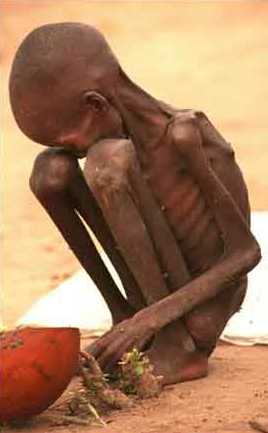
When I think of poverty, I think of the commercials for world hunger (such as this one) where there are starving children stumbling through the dusty savannah, looking like skeletons because they are so skinny. Throughout these commercials, statistics flash across the screen, stating fact such as "one-third of the world is well-fed, another third is hungry, and the remainder is starving" and "Every year 15 million children die of hunger". However, our discussion in class today of "Susie American" and her "Mortgage Scenario" made me realize that with our current economic crisis, a significant number of Americans in the same situation as "Susie" will be falling below the U.S. poverty line. I was surprised to find that currently one in six children in the U.S. lives below the poverty line. The Stimulus Bill just signed by President Obama has given hope to many American citizens facing financial challenges and the possibility of falling below the poverty line. In a transcript of his remarks after signing the Stimulus Bill in Denver, Colorado, President Obama stated: "it's a plan that rewards responsibility, lifting 2 million Americans from poverty by ensuring that anyone who works hard does not have to raise a child below the poverty line. As a whole, this plan will help poor and working Americans pull themselves into the middle class in a way we haven't seen in nearly 50 years." This bill will hopefully help all those who need financial support.

Monday, February 16, 2009

Agency and Oppression in Sri Lanka


Sri Lanka, an island country about twenty miles off the southern India, has been stricken for the last twenty six with off-and-on civil war between the government and separatist militant organization, the Liberation Tigers of Tamil Eelam (LTTE). The LTTE is now forcibly recruiting children as young as fourteen years old to join their forces. They are shooting and killing those trying to flee Sri Lanka's war, which is now one of the longest-running wars in Asia. According to the United Nations, "there were also reports civilians had been killed in fighting inside a newly demarcated no-fire zone on the Indian Ocean island's northeastern coast" (Article). Peace is actively trying to be established in Sri Lanka by the UN, but the LTTE is not responding, continuing to violate the UN's cease fire declerations. The number of civilian deaths since this civil war started in 1983 is mounting. Ron Redmond, a spokesman for the UN High Commissioner for Refugees, said, “We are outraged by the unnecessary loss of hundreds of lives and the continued suffering of innocent people inside the LTTE-controlled areas" (Article 2).
The conflict in Sri Lanka is a classic example of angency and oppression. The Agency that the LTTE pocesses is being used to oppress the civilians of Sri Lanka. The civilians are being oppressed by having their homes destroyed and their friends and relatives innocently killed because of this destructive, drawn-out war. What will it take to stop this case of agency and oppression?

Friday, February 6, 2009

Baby Bonanza!


An article from the New York Times that questions the high rate of multiple birth resulting from the lacking laws surrounding fertility clinics reminded me of my Junior Theme topic. I read Sinclair's The Jungle and Harr's A Civil Action, and my topic relates to the laws that were created to regulate their respective industries' lacking standards that were exposed in the books by each author. This article describes that "the United States has no laws to enforce those guidelines" that the American Society for Reproductive for Medicine for the in vitro fertility procedure. The invitro "treatment involves removing eggs from a woman’s ovaries, combining them with sperm in a laboratory, and implanting the resulting embryos in the woman’s uterus. (In some cases the eggs come from a donor.) The number of embryos implanted is often a judgment call and can make a big difference in a pregnancy’s outcome". Recently, some fertility clincs have been implanting up to six embryos in a single birth mother. Although this may increase the chances of a birth, it also inceases the chances of multiple births, especially when the the embryos split, or multiple embyros go through. Recently, a woman who already had six children had an invitro implant of six embryos. All six went through, and two split, resulting in the 33 year old woman having octuplets. Now she has fourteen children, all born through in vitro. As stated in the article, "the United States had retained a laissez-faire stance toward in vitro procedures, instead of regulating the process like some other countries do." Almost one-third of invitro births result in twins or more, and the numberof procedures being done has doubled in the last ten years. With these statisics and the health hazards that multiple births bear for the babies and the mother, maybe the U.S. goverment will have to step up and create regulating laws.

Wednesday, February 4, 2009

Romanticizing the Lives of Celebrities


When I was hanging out with my cousin the other day, she was reading the latest issue of Us Weekly. She was enthralled with the magazine, and kept commenting on the latest celebrity gossip, saying things like: "Can you believe he did that?" and "Did you know that he was with her?" When I asked her how she was able to keep up with the lives of celebrities so well, she told me about a website she often reads, perezhilton.com. The byline for the website is "Celebrity blog site covering news and rumors of Hollywood stars" and it is updated very frequently with the latest gossip. I found this to be a good example of something that Americans romanticize: the lives of celebrities and the gossip and rumors that surround them. Television shows such Cribs on MTV make celebrity life look like one of endless luxury, showing tours of the stars’ homes and highlighting their most lavish processions such as several very expensive cars. Shows such as this leave many Americans wishing they could become rich and famous and live in a big, beautiful house. Stations such as MTV, VH1, and E! are devoted to exposing the lives of Hollywood stars. Americans romanticize the celebrity lifestyle, making it seem much better than it actually is. Magazines such as Us Weekly, People, and Star focus on what each celebrity is dong with their lives, who they are dating, where their last vacation was, and what they last wore on the red carpet. They make it seem that the lives of celebrities are much more important than the lives of the average American, thus again romanticizing the celebrities lives to be better than their own. They also cause an obsession for some people that has resulted in an industry devoted to just following the celebrities lives and publishing them in the forms of magazines and television programs. Instead of worrying about their own lives and the problems they face, many American indulge in following the lives of overly romanticized stars. In reality, we are all human and therefore why is it so important to follow the lives of people we do not know and most likely will never meet?

Monday, December 8, 2008

Chicago defies forgotten 2nd Amendment


I found an interesting article from the Chicago Tribune online entitled, Chicago defies forgotten 2nd Amendment. The second amendment, which gives citizens the right to bear arms, has caused some dispute lately over whether individual cities and towns should be able to outlaw handguns. Recently, Morton Grove, Evanston, Wilmette, and Winnetka have all repealed their laws banning handguns, but Mayor Daley refuses to do so for the city of Chicago. He is quoted in the article: "Does this lead to everyone having a gun in our society?" he asked after the ruling came down. "Then why don't we do away with the court system and go back to the Old West, where you have a gun and I have a gun and we'll settle it in the streets?" Although he may be using hyperbole here for emphasis, he brings up a valid point: Is the second amendment posing a threat to our safety? Can people really be safe in a city where citizens on the streets are all carrying guns around? Even with the current law in place banning hand guns there were 443 homicides last year in the city of Chicago. The current policy was instated in 1983, and had not been challenged until last summer “when the Supreme Court ruled that Washington's ban on handguns violated the individual right to use arms for self-defense in the home.” Now there has been a lawsuit filed against the city of Chicago by the National Rifle Association. Mayor Daley has refused to make even the slightest change to the handgun ordinance, and therefore has decided to fight the lawsuit. Is this a matter of safety or of individuals’ rights? How should this lawsuit be ruled?

Thursday, December 4, 2008

Simplicity, Simplicity, Simplicity!

I was going through our mail the other day, and I came across a magazine that my mom subscribes to entitled "Real Simple". The tagline for the magazine is "Life Made Easier. Magazine and TV show about simplifying your life. Includes home solutions, meals , special features". I found it funny that in today's world we need a magazine to tell us how to simply our lives. It seemed almost ironic to me that in order to start simplifying, you must add reading the magazine to your routine first to tell you haw to go about doing it. I thought of the quote I had just read in Thoreau: "Our life is frittered away by detail...Simplicity, Simplicity, Simplicity! I say, let your affairs be as two or three, and not a hundred or a thousand" (Thoreau 73). Our lifestyles have become so complex, and we are often lead to feel that every tiny detail is of utmost importance. Thoreau would be disappointed that we have to have magazines telling us how to simplify our lives because we cannot do it on our own. The whole point of simplifying your life is supposed to be thinking through your own thoughts, not conforming to what others say to do with your life. However, Thoreau would definitely agree with the morals behind the magazine, that peoples' lives today are far to complex and busy, that they need to real focus on what is important. I tried to take this ideal and apply it to my own busy life, but it is quite difficult. I do not want to cut out anything that I enjoy doing, instead I would rather make more time to do those things, but that involve giving up time that is spent to homework and chores, things that are necessary that I do. In what ways can we follow Thoreau's advice in our own lives?

Monday, November 24, 2008

Health Care Reform

Since several people put down "health care" as an area of our society today that needs to be reformed the most, I decided to do a little research to find out what people are doing to change this area of our society. I found that Minnesota Senator Amy Klobuchar "is hosting a national summit on health care reform at the University of Minnesota" tomorrow (Article). They are calling the summit "Prescription for Reform," and its main goal is to find ways to improve and strengthen the health care system in the United States. The health care system is under review because with our current economic situation, many people cannot afford health care, especially those who have lost their jobs. What solution will they come up with at this conference? Will it actually be implement into our government? What effect would a change in the health care system have on our society?

Wednesday, November 19, 2008

The Self-Made Man a Myth?

I just opened my internet browser, and on my Google News homepage, one of the articles caught my eye because of its direct correlation to our discussion today about how Americans idolize those who "pull themselves up by their bootstraps". The article, entitled The Self-Made Man a Myth?, describes the best-selling author Malcolm Gladwell's new book, where he explores the idea of the self-made man through methods of out-of the-box thinking. He come to a conclusion that such a man does not exist. After we described all the characteristics of self-made men in class today and even came up with a large list of specific people, I found Gladwell's argument difficult to believe. Although he give legitimate examples and supports them, I do not think his warrents as described in the article are strong enough to disprove the common-belief in the self-made man. To me, it almost sounds like he is supporting the characteristics we listed on the board today.

His claim for why certain people were able to achieve great things is because there are things "you simply can't control" such as "luck"that are major factors in determining if one is successful. He gives the example of Bill Gates, somebody who as a class we listed on the board as being a self-made man, among other CEOs of major companiesto be sucessful men he was born in 1955. According to Gladwell, this was the optimum year to be born. The reason these men are sucessful "is not a coincidence. It has to do with the fact that the personal computer revolution happens in 1975 when they were 20 years old and that is the perfect age to be confronted with a revolution. Right? You don't have a family or kids or a mortgage. Your mind is wide open. You've got nothing at stake in the existing order of things and you can embrace some new paradigm."

I agree with Gladwell that these men did have good circumstances for sucess, but I disagree that these are not self-made men. They still were hard working, determined, came from humble beginings, and were risk-takers, all characterics that they instilled in themselves that allowed them to achieve great things.

What is the true definition of the self-made man? Does the self-made exist? Do Gladwell's warrants validate his arguement?

Thursday, November 13, 2008

Progress in the World of Video Games?


Although I almost never play video games myself, I see my brothers and their friends frequently head down to our basement and turn on the Xbox. Yesterday, my mom and I were in the kitchen and she started complaining that all the boys ever do is play "Halo", and I began to wonder if video games really were a positive technological advancement, or if they are having a negative effect on people. This article describes some of the negative effects of gaming: the "central physiological systems in the body can be affected when you play violent games without your being aware of it." Video games can be almost anti-social and involve just sitting inactively in front of the television for hours on end. Wouldn't it be better just to play an "old-fashioned"board game or go out side and toss a ball around? Or perhaps have a family-bonding game night or touch football with the neighbors?
The average video-gamer would argue no, that these are things of the past. However, new advances in video game technology has allowed for video games that focus on personal fitness. "Exercise gaming" was introduced to the market through Wii Fit, a popular game that leads you in exercises while you stand on a weight sensitive mat, and then gives you feed back on your level of fitness. This is taking video-gaming in a new direction along with our health-conscious society. Recently EA Games announced that they will be introducing a rival game to Wii Fit in 2009. The EA sports president said of the game, "we have a real opportunity to redefine the home fitness experience with a more Western cardiovascular approach and exercises that will appeal to a diverse audience, getting people off the couch and into shape while interacting with our products in a way never before possible."
Exercise gaming is a very interesting advancement in the world of video games in an effort to incorporate more physical activity into people's lives. Is this progress??? How will the typical "gamer" receive this? Will this movement be successful?

Sunday, November 9, 2008

The World's Reaction to President-Elect Obama


While viewing the pictures in class on Wednesday of the crowd's reaction to Obama's speech in Grant Park, words such as "excitement" and "pride" were used to describe the feelings portrayed by the pictures. Seeing the positive reaction of those in the United States made me wonder how the rest of the world received the election of Obama to be the next president of the United States. I found an article that described the world's reaction as "elation". According to the article, "in country after country, elation over Obama's victory was palpable, the hunger for a change of American leadership as strong outside the U.S. as in it." I was not surprised to see that there was such a positive reaction on a global scale. From London to China to Africa, people all around the world are looking to Obama to reestablish the US foreign policy for harmonious relations between the US and the world. Although this is quite a large feat, people still celebrated. I found the celbrations in Kenya, the country of Obama's late father, to be most interesting as described in this article. In honor of Obama's election, the Kenyan President declared Thursday a national holiday, "allowing celebrations to continue through the night and into a second day. " Obama's step-brother that lives in Kenya was carried down the streets with jubilation. Nelson Mandela, the first black president of South Africa, commended the President-elect, saying "Obama gave the world the courage to dream." Overall there has been a very positive reaction towards President-elect Obama thus far, and it will be interesting to see if this optimism is retained once his foreign policy is established. Are these countries excited because, in addition to history being made, they believe that Obama will do something to benefit them that has not been done in the past? Are they more excited for how it will affect the US or rather, their own country? Or perhaps both?

Sunday, November 2, 2008

Early Voting


After we talked in class about early voting and how voting day is like a deadline, and candidates have until that day to campaign as much as they can, I became interested in how early voting is affecting our current election. I found an article in the New York Times about early voting. Now 32 states allow voters to cast their ballot early without a required excuse for dong so. Early voting has been very popular this year, with 30 percent to 35 percent of voters expected to participate this year compared to the 22 percent of voters that cast an early presidential ballot in 2004. This is due in part to how "user-friendly" early voting has become. Open in some states for twelve hours a day, early voting is available at a variety of convenient locations including at grocery stores and from the windows of their cars, "A.T.M. style". Others chose to vote early because, as one voter put it, "I thought I might as well do this, I wasn’t about to change my mind.” Many people have strong opinions about this election, and at this point in the campaign few things could change their predetermined candidate choice. Early voting is also a way for people to voice their opinion that would not have a chance to vote otherwise due to obligations such as long work hours. Although some view early voting as a "leap of faith" since there has been fraudulent voting in the past, it provides an opportunity for some people to vote whom would not have voted if there was not early voting. So far, more registered Democrats have cast their ballots than Republicans.

Tuesday, October 28, 2008

IGSS at New Trier

After our discussion yesterday of the strategic plan and intrinsic vs. extrinsic learning opportunities at New Trier, I thought of the new initiative of the Integrated Global Studies School (IGSS) at New Trier. This proposed "school within a school" provides for a smaller learning environment for periods 5-8, and encompasses the disciplines of social studies, English, and science. In lieu of grades, an essay is written at the end of the year by your teachers discussing your progress and achievements as a student, with the option of requesting a letter grade designation. It is decided between the teacher and the student if they are taking the course for 4 or 9 level credit. It is an alternative learning environment to the typical New Trier structure because it allows the student to "direct the path of their own education" according to the IGSS website. Its mission, "driven by individuals whose open-mindedness inspires the spirit of inquiry, whose personal involvement is fueled by compassion, and whose convictions lead them to be responsibly active, both locally and globally, in the world outside the walls of New Trier," puts an intrinsic learning spin on the original mission statement from the strategic plan. Last year IGSS was unsuccessful in launching because there was insufficient enrollment among the class of 2011, so this year it has been expanded and restructured to also allow the class of 2010. This is an interesting attempt to stray from the typical extrinsically motivated learning style at New Trier, and try to instill intrinsic learning values in the students. It will be exciting to see where this goes in the next few years, if it is able to start up. How will colleges react? Will hurt or help a student get into a "good college" ? Will it be more beneficial to students/Will they learn more because they are choosing what they learn? Will it be more or less helpful in preparing them for the "real world"?